
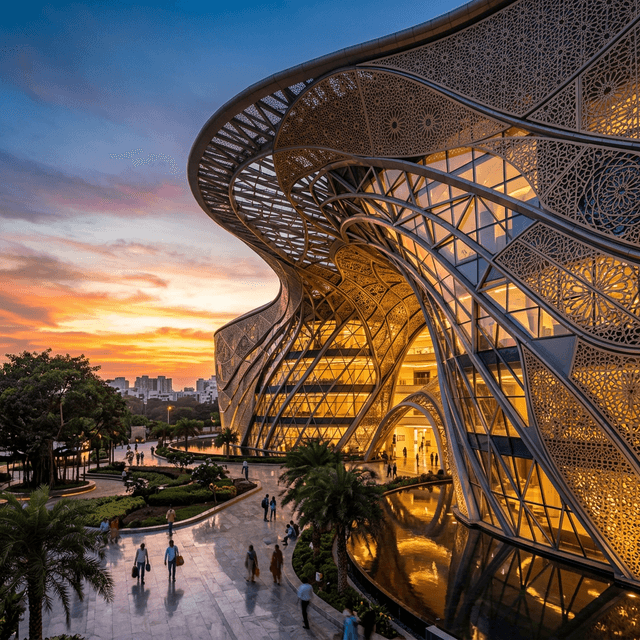
Is Rhino/Grasshopper just a stylistic trend in India, or a tool for solving complex structural problems? Cases from Bangalore.
Walk through any top architecture school in India today and you will find Grasshopper scripts generating facade patterns, parametric models optimising solar shading, and student presentations filled with animated form-finding sequences. Computational design has arrived in Indian architectural education with considerable force.
The question worth asking is whether it is being used as a tool or as an aesthetic. The distinction matters. Parametric workflows are genuinely powerful when they are encoding design intelligence — when the parameters represent real structural, environmental, or programmatic variables. They are superficial when they are simply generating complex geometry for its own sake.
In Bangalore's growing tech-adjacent architecture scene, both are visible. On one end, firms working on large campus projects are using BIM and parametric tools to coordinate complex multi-disciplinary projects, test environmental performance in real time, and reduce construction waste through precision fabrication. This is computational design as problem-solving.
On the other end, competitions and student work frequently feature algorithmically generated forms that, on closer inspection, have no structural logic, no constructibility, and no relationship to climate or site. The tool is being used to produce novelty, not to solve problems.
The distinction maps onto a broader question about architectural education in India: are we training students to think computationally, or to use specific software? Thinking computationally means understanding systems, feedback loops, and optimisation. Using software means knowing which buttons to press.
The most exciting practices emerging in cities like Bangalore and Pune are those bridging both. They are using grasshopper scripts to generate brick patterns derived from traditional regional geometry, or using computational methods to test the structural performance of forms inspired by vernacular precedents. They are finding a specifically Indian computational design language — not importing one wholesale from Europe or North America.
Topics
Written by
BIM Specialist
Sahil is a BIM specialist and computational design researcher based in Bangalore, working at the intersection of parametric methods and South Asian building traditions.